Impractical Distillers: Vol 2.3
What's Your Proof?
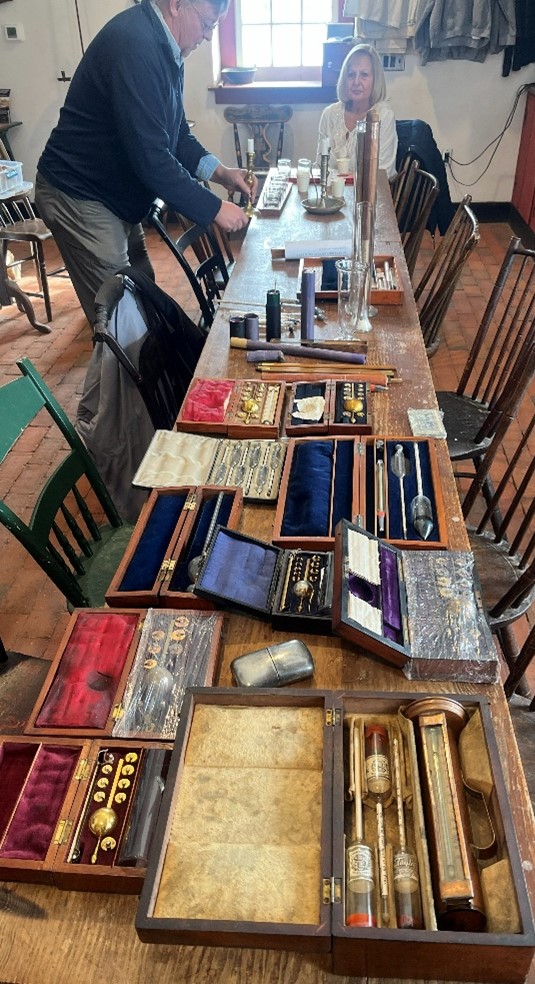 The practice of distilling is part science, part art. Recently a visitor to the distillery enthusiastically shared his personal interest in one of the most useful scientific measurement tools used in distilling – the hydrometer or alcoholometer. A few days later he returned with “part” of his extensive collection of instruments used to determine the “proof” or percentage of alcohol in various spirits.
If you recall high school physics class, you may remember Archimedes’ principle; a buoyant force pushing up on an object immersed in a fluid is equal to the weight of the fluid that is displaced. This talented 3rd century BC Greek scientist had many mathematical achievements, but his pragmatic concept led to the ability to determine the percentage of alcohol in a sample. Galileo and later Robert Boyle advanced the theory. Boyle coined the name “hydrometer” for the tool that emerged from the research.
In the late 1780’s Johann Georg Tralles recognized that density of water differs from other liquids and developed scales to measure this concept. The alcoholometer is a specific scale used to determine the concentration of alcohol where no sugar or other dissolved substances are present .Bartholomew Sikes and John Dicas developed scientific instruments in London. Sike’s instrument was adopted by the British excise authorities while the Dicas version was adopted by the American government in 1790.
The alcoholometer is relatively simple to use. At the Eichelberger Distillery we use ours daily. From measuring low wines from the stripping still, separating heads, hearts, and tails from the spirits still, diluting for barrel entry and finally determining final proof before bottling, we float the alcoholmeter in a cylinder filled with spirit. Here are some examples of vintage and modern instruments:
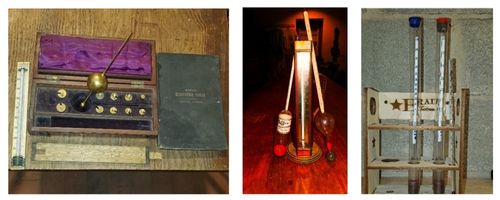
 Alcoholometers are calibrated to meet Tax and Trade Bureau (TTB) standards. The more modern glass floating scales are marked from 0 to 200.Halfway between is a “P” indicating proof or 100 proof. Temperature is important because volume of the liquid changes with the temperature. Each set has a thermometer. The Sikes thermometer is attached to an ivory scale, The Greibel thermometer is contained in the cylinder, and the Brady is standard thermometer. The percentage alcohol determined at 60 degrees F is called True Proof. If the measurement is taken at temperatures other than 60F it must be converted by the use of tables or charts as depicted by the Sikes Hydrometer Manual.
Early Pennsylvania distillers estimated proof. The term goes back to the 16th century England. The British loved to tax things and spirits were taxed depending on alcohol content. A “burn-no-burn” test was utilized to determine a liquid that would ignite above proof and would not ignite under proof. Gunpowder soaked in spirit at 100 proof and above will ignite but will not burn at under 100 proof. By the end of the 17th century measurements based on specific gravity were introduced. By 1848 the US measured proof based on percentage alcohol and reported as alcohol by volume or abv. Simply, 100 proof is 50% alcohol.
The distillers at the “Eichelberger distillery” of the past certainly were aware of proof as they were charged $1.25 for measuring proof or gauging a delivery of barrels to Baltimore in 1825. The numbers on the scales are small, and eyes of the Impractical Distillers are old. But we do our best to get accurate readings at various points in the process of turning fruits and grains into spirits at the Eichelberger Distillery at Dills Tavern. Stop in to experience the process, observe the tools and techniques as you try your hand … or eye at using the instruments. There’s your proof!
~The Impractical Distillers: Sam and Murray