Impractical Distillers: Vol 2.4
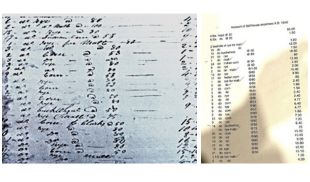
The Eichelberger Distillery at Dills Tavern is fortunate to have the Eichelberger Ledgers. This treasure trove of historical information covers the time span of the entrepreneurial Eichelberger family who owned the property from 1800-1833. Fifteen hundred handwritten pages chronicle the many business activities on site. Displayed is one example of an inventory conducted in 1810. The page depicts an accounting of the grain purchased during the year. No other such inventory appears anywhere else in the ledger.
 This one-time account demonstrates the quantities and varieties of grain purchased for distilling.The four grains listed were 125 bushels of rye, 33 bushels of buckwheat, 131 bushels of Indian corn and 15 ½ bushels of rye malt. Also listed was 10 lbs of hops. At about 50 lbs per bushel this represents over 7.6 tons of grain.
We have not found a specific mash bill for the whiskey made, a reasonable estimate can be made from the grain on hand. Grain was purchased at different times probably dependent on growing seasons. Rye was harvested in early summer, corn in fall. They likely purchased as it was available, in amounts they could afford when they had the confidence they would all of it. Rye and corn as the main ingredients would be consistent with McHarry’s 1808 book The Practical Distiller which lists recipes typical of the Central Pennsylvania region. Rye outweighed corn because rye was the dominant grain in Pennsylvania distilling. Commonly rye made up at least 50% of the mash bill. Buckwheat made up a mere 12% of the inventory.
Was it a flavor enhancer or back-up grain? We can’t be sure. Which Indian corn was used? There were numerous varieties, many lost in time. We have no definitive answer. The cost of corn varied from 50-60 cents per bushel; rye was 80 cents per bushel and buckwheat 50 cents.
The inclusion of hops was puzzling. Hops is associated more with brewing than distilling. Hops isn’t found in mash bills and the TTB has a definite opinion about including it in a whiskey recipe. We eventually stumbled onto the fact that hops was used for making yeast.Hops helps suppress bacteria, especially helpful for mashing in wooden barrels. Hops also helps stabilize yeast cells and even helps attenuate the conversion of sugar from grain into alcohol by yeast. McHarry recommends – always have enough!
They did not understand the science of different mash bills, optimizing yields and yeast in 1810. By observation and record-keeping they learned what worked. One thing they did understand was hard work. Think of the labor it took to harvest, process, malt, ferment, and distill 7.6 tons of grain – by hand? Stop by the Eichelberger Distillery to see how they did it and taste whiskey like it tasted in the early 1800s.
~The Impractical Distillers: Sam and Murray