NYCHAPS Rev War Project Vol 1.9
In the summer of 2026, the Northern York County Historical and Preservation Society (NYCHAPS) installed a Patriot display board on the side of the barn adjacent to its tavern.The board contained a list of over 700 names of men from northern York County (modern day Carroll, Franklin, Monaghan, Warrington and Washington Townships along with their associated boroughs) that provided support to the Patriot cause.
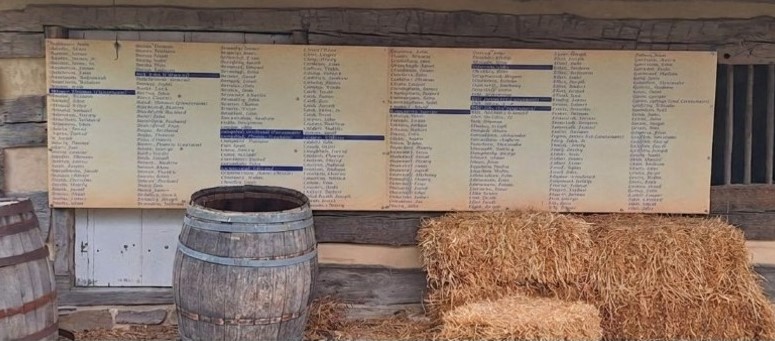 The names with a blue background represented men that were part of Washington’s Continental Army, possibly initially as Associators. Others served as representatives of their townships on various York County committees formed to govern during a time of war, or as County officials carrying out orders of the state and county committees. The remaining vast majority of men were part of the Pennsylvania militia.
A standing militia, given Pennsylvania’s colonial government’s Quaker leanings, did not exist at the start of the American Revolution. While there were volunteer organizations of Associators that had fought in the French and Indian War and provided for the defense of the colony, it wasn’t until March of 1777 that Pennsylvania enacted legislation creating a militia. Prior to that time, men from the ranks of the Associators marched to Boston and to Washington’s Flying Camp.
When the Militia Act was passed in March of 1777, all able-bodied men between the ages of 18 and 53, with certain exceptions, were required to serve in the militia, obligated to muster for active duty and attend stipulated exercise days. These men were subject to being called up to serve and assist Washington’s Army as well as to assist in the defense of the frontier; the period of active duty was, however, typically limited to 60 days. Those who refused to serve were subject to fines and double taxation, or they could hire a substitute to serve in their stead. The use of substitutes was not uncommon – a younger son might substitute for a father needed on the family farm, an unmarried brother might substitute for a brother with a family, a servant might be sent instead of a master, a man who could afford to pay another to take his place was allowed to do so. But if no one showed up, a fine was levied.
According to one study of the militia:
In the period 1777–1783, income from militia fines surpassed £6,000,000. Half of this money provided Pennsylvania with one-sixth of its revenues in those revolutionary years. Lieutenants spent the balance for goods and services provided to the militia by thousands of inhabitants, many of whom earned cash for the first time.
In order to effectuate the Act, civilian County Lieutenants and Sub-Lieutenants were appointed. For York County, Richard McAllister was appointed as the first County Lieutenant and Colonel Matthew Dill was later appointed as a sub-Lieutenant for the County. These men were responsible for filling the ranks of the militia and recorded the fines collected for nonattendance of exercise and for the non-performance of militia duties, as well as payments paid for recruiting services, for hauling of baggage, apprehending deserters, disarming Tories and warning the militia to march in a Statement of Accounts. Records also reflect that a “Court of Appeals” was established to review whether or not men participated in the required musters and exercise days and if not, whether the excuse was valid. Some men were excused due to health reasons, but many were nevertheless fined for non-attendance at drills and musters.
Across Pennsylvania, the militia was organized into battalions in each of the 11 counties and in the City of Philadelphia. Each battalion had eight companies created from its townships, and each company of 80 – 100 men had eight classes. It was through these class designations that the militia was called into service, and as all men from a particular company were not called up at the same time, those that remained were able to provide the necessary labor and defense needed locally.
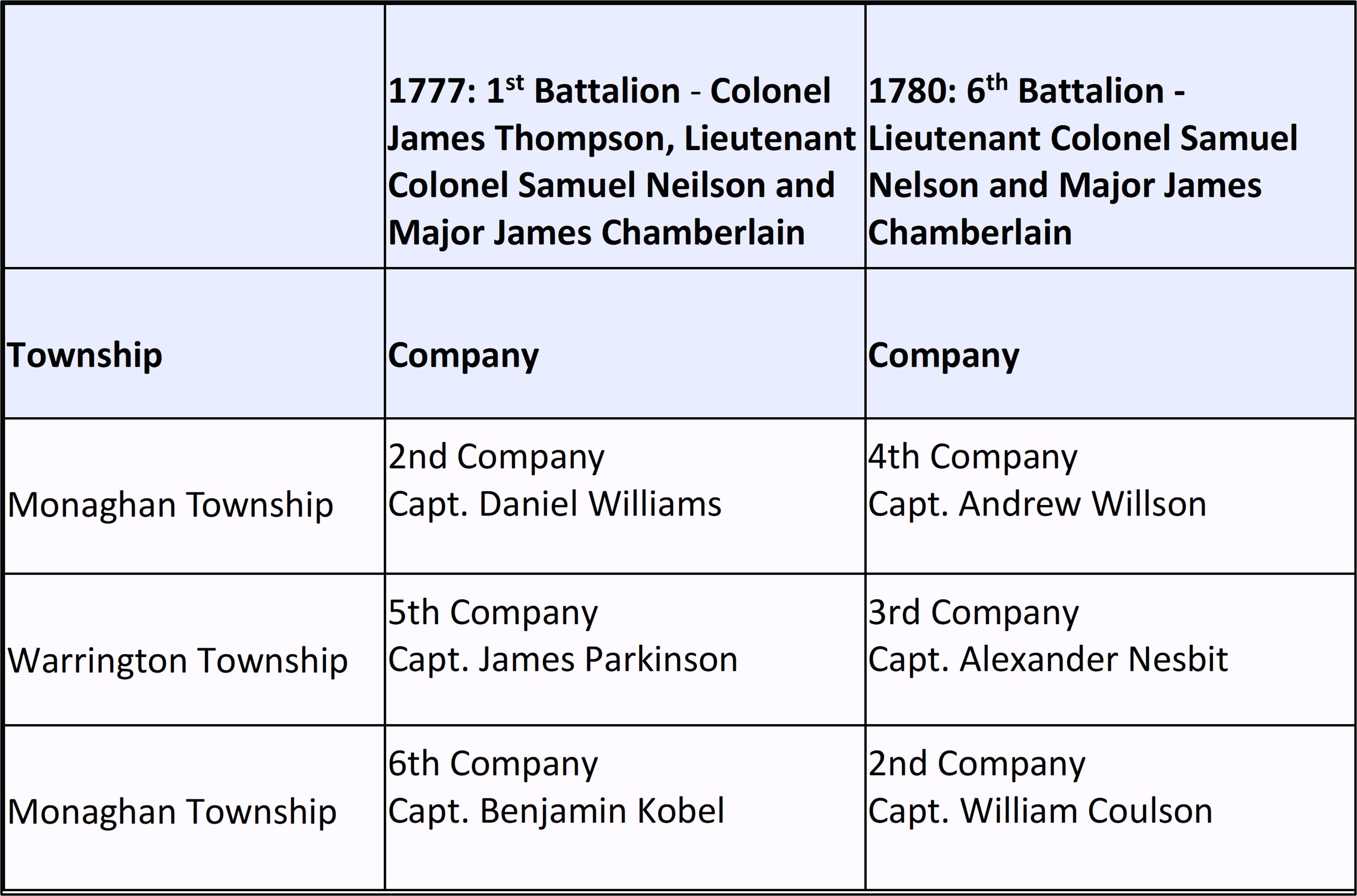 In 1777, both Monaghan and Warrington Townships were part of the Pennsylvania militia’s 1st battalion. However, the numbering of the militia units changed every three years even though the composition of each unit recruited from a given area tended to remain more or less the same except for casualties and new recruits. As shown on the PA Archives revolutionary war militia webpage (York County Revolutionary War Militia | Commonwealth of Pennsylvania), the companies associated with each of the townships were as follows: Companies associated with each of the townships are identified in the chart.
Importantly, if and when the militia was called out, it was called out by class, such that the 1st class of each of the eight companies in a battalion would be called before the 2nd or the 3rd, etc. As a result, when a class was called, men were placed into new companies under different leadership that what was in place when exercising. For example, when the 1st class was called, the 1st class men of each company in the battalion would be expected to assemble under the leadership of the captain of the battalion’s 1st company.
Throughout 1777, the militia was called out repeatedly to support the Continental Army and assist in the defense of Philadelphia, especially through the Battle of Brandywine on September 11, 1777 and the Battle of Germantown on October 3, 1777. While the militia Act had only been passed in March, by early April, the news had reached Philadelphia and Pennsylvania’s Supreme Executive Council of the “probability of Gen’l Howe’s intention of marching across New Jersey to this City.” By April 25th, generals had been appointed and the 1st class of militia from various counties, including York, were called to march toward camps to be established at Bristol and Chester, near Philiadelphia. In June of 1777, the 2nd class of the York County militia was initially called into service. However, at that time, the York County Lieutenant had not yet formed the necessary battalions and no classes marched from York County.
On July 28, the 1st Class of York County was again called up. This time, they marched out toward Chester. By early September 1777, members of the 1st class of the 1st battalion of York County were in Wilmington under Captain Dodds (38 men) and were under the command of Colonel James Thompson in General Potter’s Brigade of about 1800 men. Potter’s brigade accompanied the Continental Army as it marched southwards as far as Newport, Delaware. In fact, Potter’s Brigade, including the York County Regiment under Colonel James Thompson would have been at the Battle of Brandywine on September 11th. The tour of the 1st class militia of York County would then have ended in October, a few days after the battle of Germantown on October 3, 1777.
On September 6th, the 2nd class from York County was again called up to rendezvous at Darby with other units. By September 13th, General Potter and the balance of his brigade had been sent to Valley Forge, with General Maxwell’s New Jersey force, to guard the depot of stores there but without sufficient wagons to remove the stores, they were forced to abandon them and withdraw to Swede’s Ford upon the approach of British infantry. On September 12, the 3rd class of York County had been called into immediate service. However, the order was not received by Richard McAllister, the County Lieutenant, until September 20th and he reported to the Council some difficulty in gathering the militia as well as a lack of available arms.
On September 26, when the British marched into Philadelphia, the Pennsylvania militia, including Potter’s Brigade moved to a new encampment at the Trappe in Providence Township. By October 21, Washington moved his army forward into Whitpain Township, within fifteen miles of Philadelphia. Included among them were 111 rank and file militia men under Major James Chamberlain of York County’s 1 Battalion. These men were presumably the Class 2 and 3 men that had been previously called to serve. It was also reported that more began to march on October 27.
According to “The Pennsylvania Militia in 1777” in the Pennsylvania Genealogical Magazine, at the end of October:
At this time Potter’s men were scattered at different posts extending "from Vanderings on the Schuylkill to Grubbs on the Delaware.” These detachments included 50 men at Boone’s Dam, 30 at Gray’s Ferry, 100 at the Middle Ferry, 25 at the Upper Ferry, and a reconnoitering party under Major Miller near Vanderen’s mill. In addition, Potter kept a guard of about 100 men in and about his own camp. He now sent a detachment of an additional 100 men with the baggage wagons back six miles from his encampment where the wagons were to be unloaded and "carridges” made for the wagons to move the [mill] stones from Brandywine. On 3 November, he reported without identification that he had again been reinforced so that his total brigade numbered, exclusive of officers, about 950 men with arms, and 300 without.
Having been called up on October 23, the 4th and 5th classes had begun to march from York County by early to mid-November. The County Lieutenant, Richard McAllister, reminded the Council that the great “Number of Quakers, Mananest [Mennonites] and Dunkers in this County ocations [occasion] the Companeys [sic] to be so hard to be filled up,” Nonetheless, York County’s 4th class militia men were with General Potter when he crossed to the east side of the Schuylkill River on December 1, 1777.
By December 22, York County’s 4th and 5th class of militia had detached from Potter’s brigade and were now with General Armstrong at camp in Montgomery, PA. During the winter of 1777-1778, while Washington and his army were at Valley Forge, the Pennsylvania militia were ordered to guard the region north of Philadelphia, between the Schuylkill and the Delaware Rivers. They were to prevent farmers from selling their products to the British in Philadelphia and to defend the citizens from British raiding parties. On 9 January 1778, 25- year-old John Lacey was promoted to brigadier general, and ordered to assume command from General Potter, who had requested leave to attend to family matters.
Under General Lacey, the 6th and 7th classes were called up in January and ordered to join Lacey’s camp near Graham Park. In March, the 8th class was called up to relieve Continental troops in Lancaster which had been ordered back to Valley Forge. General Lacey’s militia numbers dwindled from 400 when he took command to between 60 and 100 by midFebruary. The York and Cumberland County militia, for instance, had been delayed by bad weather and difficulty in crossing the Susquehanna River, and by later in February Lacey had nearly 500 men in camp, but dwindled to 250 by April 19. The efforts under Lacey to deter the British were largely unsuccessful due to a number of reasons and by mid-1778, General Potter had resumed command.
As the Philadelphia campaign came to a close, later classes of militia were primarily called out to defend the frontier or to guard prisoners and/or supplies. In the Spring of 1779, for example, the 4th class of militia was called out to go the frontier.[1] In 1781, about 100 men from the 4th class of York County Militia were called to guard British prisoners at Camp Security, which had been newly constructed to the east of York. Subsequent callouts to guard prisoners followed.
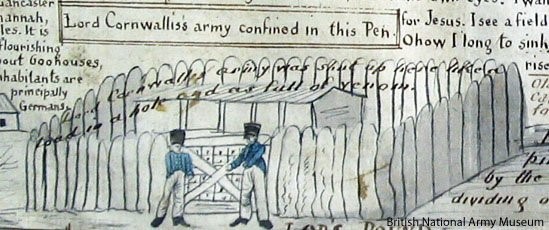
Stockade at Camp Security, possibly according to British Sgt. Lamb
The militia may also have been sent to Albemarle County Virginia where Nathanael Greene’s Southern Army was located to assist in guarding supplies as Albemarle County, Virginia was one of the major supply, rendezvous, and staging points for troops moving toward Greene in the Carolinas. In the records of the appeals held for Monaghan Township on October 12, 1781 at the house of James Dill for the 6th and 7th Classes of Captain Wilson's company, the notes for Abram Williams, indicated he “Went to Albemarle.”
The ordering and call out process of the militia, the use of substitutes and the scarcity of some records, make it difficult to describe with any certainty the actions of the militia from northern York County, but it must be said that they, along with thousands of others, were called to serve the cause of liberty and patriotism in the founding of our country