
NYCHAPS Rev War Project Vol 1.10
During the American War of Independence, the rural townships of northern York County, Pennsylvania—including Warrington, Monaghan, Washington, Carroll, and Franklin— mobilized their citizens to sustain the struggle for freedom. Men from these communities enlisted in the Pennsylvania Continental Line, stood muster in local county militia battalions, guarded prisoner-of-war camps such as Camp Security, and provided vital supply taxes and logistics to George Washington’s army. Today, dozens of these soldiers and civil patriots lie buried in churchyards, meeting house grounds, and family burial plots scattered throughout the rolling hills of northern York County. From two of our local cemeteries, below are the stories of nine of these patriots.
Dillsburg Cemetery (Carroll Township)
1.Lieutenant Archibald Campbell (1755–December 4, 1784) Military Service: Lieutenant, Continental Army, 6 Pennsylvania Regiment. th Biography: Archibald Campbell served as a commissioned Continental officer in the renowned 6th Pennsylvania Regiment. His unit fought in several of the war’s most pivotal campaigns, including the Battle of Brandywine, where the regiment was commended for steadfast bravery, and Campbell was reportedly wounded. Dying young in 1784 without issue, he bequeathed his estate to his sister Sarah (wife of Joseph McDowell) and brother John Campbell, appointing his brother Captain Thomas Campbell as executor.
2.Captain Thomas Campbell (1750 - January 15, 1815) Military Service: Captain, Continental Army (Thompson’s Pennsylvania Rifle Battalion/1 Pennsylvania Regiment; later 4 Pennsylvania Regiment). st th Biography: Born near Dillsburg in 1750, Thomas Campbell was among the earliest York County patriots to take up arms. In the summer of 1775, he enlisted as a rifleman in Captain Michael Doudel’s company—part of Colonel William Thompson’s famed Pennsylvania Rifle Battalion (later designated the 1 Continental Regiment)—which completed an arduous rapid march to Cambridge to join the Siege of Boston. Commissioned an officer in the 4 Pennsylvania Regiment in early 1777, Campbell served across the major engagements of the Philadelphia Campaign, including the battles of Bound Brook (April 1777), Brandywine (September 11, 1777), and the night assault at Paoli (September 19, 1777).
During the Battle of Germantown on October 4, 1777, Campbell suffered a nearly fatal wound: while raised in the act of taking aim at the British line, an enemy musket ball struck his wrist, passed entirely through it, penetrated his chest/breast, and had to be surgically extracted from the opposite side. Though the severe injury caused painful infirmities and ailments that persisted for the rest of his life, he returned to duty. He endured the encampments at Whitemarsh and Valley Forge (winter 1777–1778), fought at the Battle of Monmouth (June 1778), and served in Major General John Sullivan’s 1779 Sullivan
Expedition against the Six Nations. A published 1809 letter from Campbell details the tragic September 13, 1779 capture and death of Captain-Lieutenant Thomas Boyd during that expedition, recounting how Campbell and Lieutenant Simpson personally interred Boyd’s mutilated remains at Genesee Castle. Promoted to Captain of his company in 1781, Campbell served until the cessation of hostilities in January 1783. Following the war, Campbell returned to his substantial landholdings in Monaghan and Warrington Townships and became a leading statesman: he served as a delegate from York County to the 1787 Pennsylvania Convention that ratified the United States Constitution, was elected York County Commissioner in 1789, represented the region in the Pennsylvania House of Representatives (1793–1800), and served as a Pennsylvania State Senator (1807–1811). He died suddenly in January 1815 in Gettysburg and was interred at Dillsburg Cemetery.
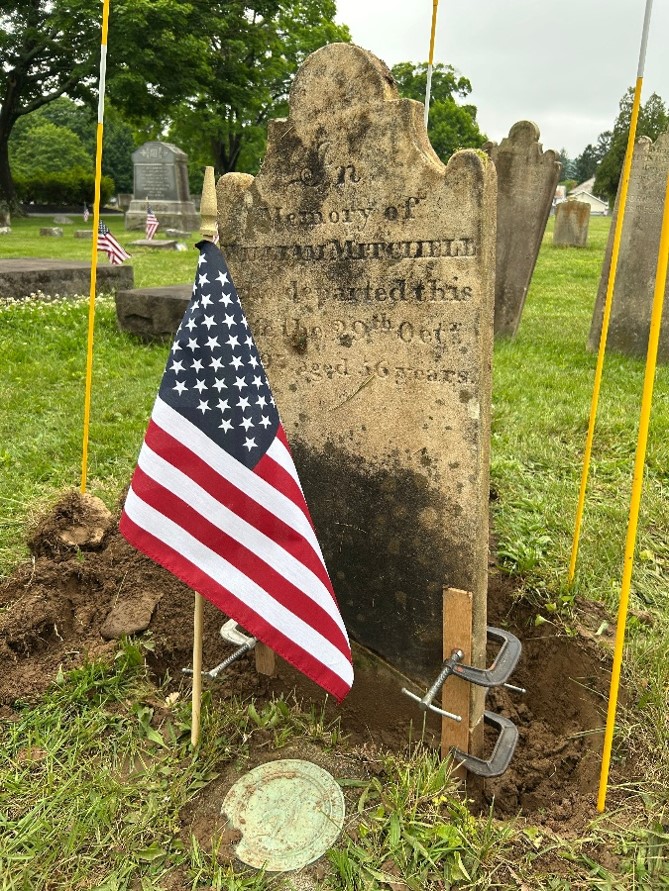 3.Captain William Mitchell (Died 1797)
Military Service: Captain, Pennsylvania Militia
Biography: An early patriot, William Mitchell was elected in November of 1775 to York County’s Committee of Observation. In addition to commanding militia companies, in July of 1776, he was appointed a judge of elections for the 5th District of York County in the election of members to the state’s constitutional convention. In 1779, Mitchell also served as an Agent for Forfeited Estates for York County’s 5th District, confiscating and auctioning Loyalist estates.
He was appointed Justice of the Peace in 1779 and represented York County in the Pennsylvania General Assembly in 1780 and 1787. Already an owner of over 300 acres, in 1794, he acquired an additional 200 acres of land in Monaghan Township.
Monaghan Presbyterian Church Cemetery (Old Monaghan, Dillsburg)
4.Lieutenant Thomas Black (1751–September 9, 1820)
Military Service: Continental Army; Lieutenant, York County Militia 5th Company, 6th Battalion (1779)
Biography: Born near Gettysburg in 1752. According to family history, Black entered the Continental Army as a private, was with General Washington at Brandywine, and engaged in other hard-fought battles. Black then served in the county militia through the war’s end and beyond. Sometime during the war, he bought a tract of land near Dillsburg. His first wife, Martha Boner/Bonner Black, died at the birth of an infant son while Black was with his regiment in the Eastern Campaign.His only surviving son from this marriage married the only daughter of Willliam Porter. His second wife was Martha Bracken, with whom he had nine children.He was an elder and precentor in the Monaghan Presbyterian Church and it was said his voice was so strong and clear that it could be heard more distinctly in the field than that of any other commander in his battalion of militia. In 1797, he was appointed Justice of the Peace for Monaghan Township, where the 1798 Federal Tax roll records him living in a 25'x24' log home on 136 acres.
5.Private Joseph Bradley (1756 - 1797)
Military Service: Private, York County Militia.
Biography: Born into a Quaker family, Bradley subsequently joined the Presbyterian faith. He served as an enrolled private in the York County Militia during the Revolution.
6.Ensign Samuel McMullin (1749 - October 6, 1805)
Military Service: Ensign, York County Militia, 6th Battalion.
Biography: The McMullin family were early settlers of Monaghan, later Warrington Township. Samuel McMullin was a member of Colonel Parkinson’s Battalion of York Co. Militia and with the Flying Camp in New Jersey in July, 1776. He was ensign in Lieutenant Colonel Nelson’s Company in 1779. On April 27,1780, he married Jean Ross, with whom he had seven children. His wife was the daughter of William and Jean Nesbit Ross and the sister of William Ross (founder and namesake of Rossville). Through her mother, she was also related to Alexander and John Nesbit. McMullin’s sister married Lieutenant Colonel Samuel Nelson. He owned tracts of land lying on the road between Dillsburg and Rossville where he owned a red brick mansion. According to the tax list of 1781, he owned 450 acres in Warrington Township although by 1783, he was assessed on only 300 acres.
7.Lieutenant Colonel Samuel Nelson (February 7, 1742 - November 8, 1802)
Military Service: Lieutenant Colonel, York County Militia, 1st and 6th Battalion.
Biography: Samuel Nelson came to New York at the age of twenty-one and from there made his way to York County. On March 9, 1769, he married Mary McMullin,
daughter of William McMullin, an officer in the Provincial Government of Pennsylvania, with whom he had nine children. He was a soldier in the Revolutionary War. In 1776, Nelson was a Captain in Matthew Dill’s Fifth Pennsylvania Regiment and served in the Flying Camp. According to the pension application of William Beans, Nelson was present during the New York campaign and at Trenton in December of
1776 where he was with the men sent to cross the river below Trenton but unable to do so due to the impassable conditions of the river. In 1777, he was advanced to the rank of lieutenant-colonel of the 1st Battalion of York Co. Militia, later the 6th Battalion. According to the tax list, in 1783, he owned 160 acres in Monaghan Township. In 1786, the Commonwealth awarded him a 150-acre land grant in Monaghan Township. He was appointed a commissioner of the third class for York Co. in 1801, but died before his term expired.
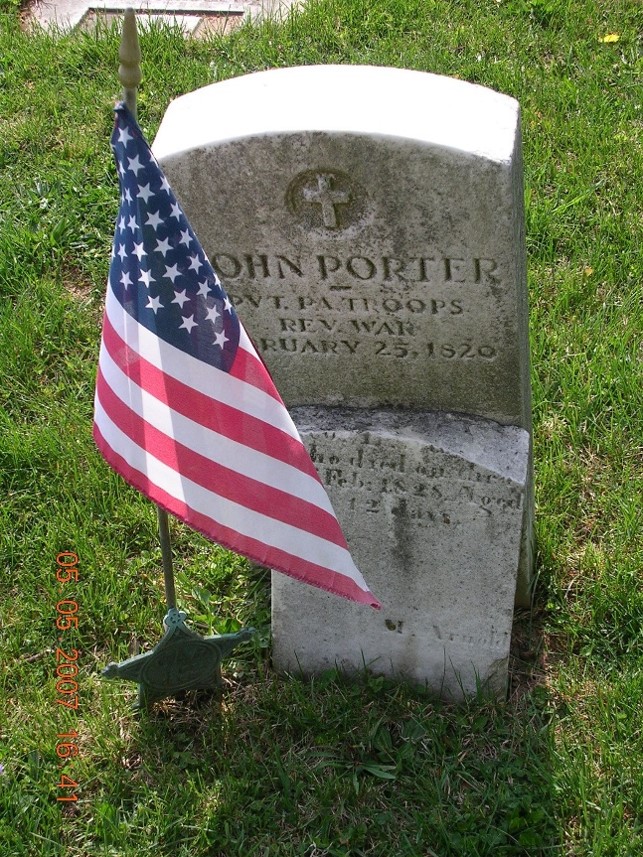 8.Private John Porter (1742 - February 25, 1820)
Military Service: : Private, York County Militia, 1st Battalion, 2nd Company (1777) (Captain William Dodd’s Company).
Biography: Born in Donegal, Ireland, Porter served as a private in Captain Dodd’s militia company. He moved to Monaghan Township around the time of the revolution and purchased farmland adjacent to Thomas Black. In 1787 he married Mary Ross, daughter of William and Jean Nesbit Ross of Tipperary Plantation, Warrington Township, with whom he had 6 children.
9.Lieutenant William Porter (June 15, 1739–February 7, 1824)
Military Service: 2nd Lieutenant, York County Militia, 2nd Company (Hamilton Bann Township under Captain James Agnew), 2nd Battalion.
Biography: The older brother of John Porter, William was born in Donegal, Ireland, and emigrated to Pennsylvania, where he first settled near Gettysburg. He was a 2nd lieutenant of the Hamiltons Bann Township Company when the militia was ordered to New Jersey in 1776 as part of the Flying Camp. According to family history, William and his brother (John?) were at Trenton in December, 1776 where they were among those left to “guard the camp on the Assunpink while Washington led his troops to Morristown” and while later making their way to Princeton “the two took refuge from rain and sleet under a tree and were standing close together reloading their rifles under the protection of their broad-brimmed hats when a shot from Cornwallis’ retreating riflemen pierced his [William’s] abdomen" - he recovered and
continued to serve. Like his brother, he moved to Monaghan Township around the time of the revolution and purchased farmland adjacent to Thomas Black. In 1779, he served on the Committee of Elections for York County and was appointed Assessor the same year; he became a constable for Monaghan Township (1780-81). He was also an elder in the Monaghan Presbyterian Church and succeeded Thomas Black as precentor. He was married twice; first to Martha Ross in 1770, older sister of Mary Ross (wife of John Porter), with whom he had eight children and, secondly, to Jane Clark, a sister of General John Clark of York County and widow of William Coulson, with whom he had three children.