Dills Tavern: The Garden Shed: Vol 1.7
 Gardeners with large gardens find August their busiest time of the year. Many vegetables are maturing, and gardeners spend so much time processing and storing for the coming winter. Even if you buy large quantities of produce for such activities instead of growing them, August will often be the month you do more of it than any other month.
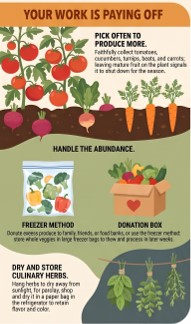
Hopefully tomatoes, cucumbers, turnips, beets, carrots, and other veg guys have provided you with healthy meals. If you're getting more than you can eat or process there are usually family, friends, neighbors, or food banks that will joyfully accept your abundance, even if it is just a small amount.
Faithfully checking and collecting crops is particularly important at this time of year. Garden pests are prolific breeders and voracious eaters of plants and fruits.
If you are careless and leave things unpicked for too long you can be sure insects and critters will take every opportunity to enjoy them for you. Regular harvesting is also important for increasing your harvest. When mature fruit is left on the plant beyond maturity it internally signals the plant that the season is ending. The plant then begins to shut down and stop producing more fruit. If you're blessed with a really large harvest, and can't handle it all before it would start going bad, place it in the freezer in large freezer bags. Then as you get time to work on it in the next few weeks, remove them from the freezer, let them thaw a few hours, and process them as usual.
Culinary and medicinal herbs can be clipped in early August, and hung to dry away from sunlight for later use. This gives the plants time to heal from your cuts and produce another harvest by late September. Then when harvested again they have time to heal before our first anticipated frost around October 25th. Remember to always harvest when plants are dry.
Parsley is an odd one.You can freeze it like other herbs, but if you hang it to dry it will lose its flavor. To dry parsley collect it, chop it, and place it in a shallow layer in a paper bag. Put the bag in your frig, or at least a cool, dry place. Every couple of days shake up the bag, so the parsley doesn't get matted and all the parsley gets equal, open drying time. After several weeks your parsley should be dry and retain its flavor and much of its color.
Clean Up and Clean Out
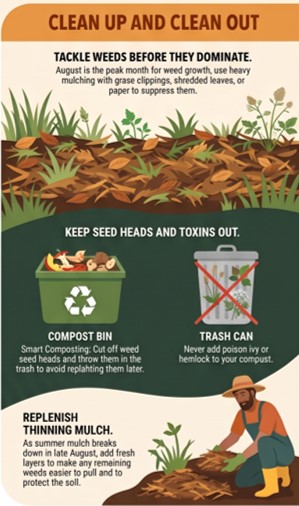 There will always be weeds to tackle, but it seems August is when they really launch their campaign for world domination. There are some tried and true methods you may have been doing to cut down on the amount of weeding you have to do, such as relying on heavy mulching or using row covers.
By August, and into September, grass clippings and shredded leaves or paper have started to break down and wear thin. Adding more mulch will help continue controlling weeds and make them easier to pull.
When you weed, cut or tear off any seed heads and throw them in the trash. Many seeds will not be killed by typical composting, and will be planted and grow wherever you spread the finished compost. The rest of the weed can be thrown into the compost. Don't add toxic plants like poison ivy or hemlock to your compost.
They are Coming for You!
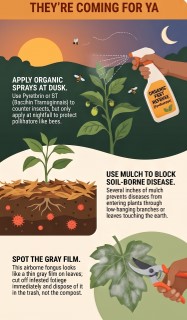 Diligently watch for diseased and insect infested plants. August seems to be when they are both most prolific. Countering them as soon as you spot them can keep healthy plants from becoming infected or infested.
At the first sign of insects or the damage they cause, you can try to counter them with organic sprays, such as Pyrethrin, BT (Bacillus Thuringiensis), or the DIY formula shared in our June/July newsletter issue. These may kill all insects, so use them at dusk when pollinators and other garden friendly insects have gone bed.
Some diseases are soil borne, and enter a plant through branches or leaves touching the earth. This is another excellent reason to use several inches of mulch around your plants. If a soil borne disease gets into your plant it will infect the entire plant in a short time. It will also infect neighboring plants the infected plant touches. It's best to simply remove the infected plant entirely as soon as you see evidence of a disease.
Fungus diseases are air borne. The most prevalent in our region is powdery mildew, which looks like a thin, gray film over a plant's leaves. At first it only affects the outer leaves that were exposed to cool, damp air at night.
However, its spores will spread quickly to other leaves and other plants by the wind or heavy watering from either rain or your garden hose. Cut off the infected leaves, and put them in the trash. Then spray the rest of the plant in early morning with the DIY formula I shared in our June/July newsletter issue. Do not throw infested or infected plants or parts into the compost pile. They should go immediately in the trash. Otherwise, you will spread insect larvae or disease to wherever you later use the finished compost.
Let’s Keep It Growing
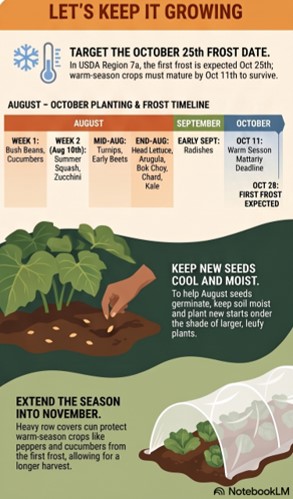
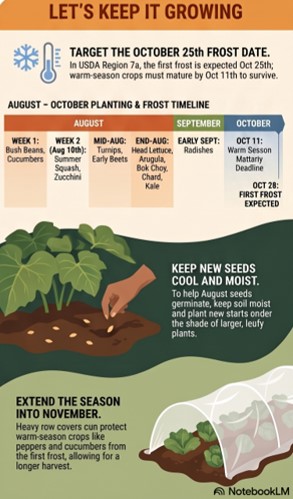 This year's expected first frost in our USDA growing region of 7a is October 25th. That's 85 days from August 1st. Still time to let our gardens produce more for us.
Temperatures, especially at night, will become cooler by then, so we back that date up 14 days to determine what warm season plants will mature by frost. That means we can still plant anything that will mature by October 11th. For cool season crops just use the expected frost date, because these plants will tolerate cool temperatures and a light frost.
Opt for the earliest maturing varieties to get the most complete harvest. So seeds have the best chance of germination, always keep the soil moist to lower soil temperature in the August heat. Let’s Keep It Growing Planting under leafy plants that partially shade them from the sun can also help.
Bush beans and cucumbers can be planted during the first week of August. Summer squash and zucchini should produce well if planted by the 10th. Early varieties of beets can be also planted, but they must have cooler soil to germinate. Turnips can be planted up to mid-August. Cool season crops, like most varieties of head lettuce, arugula, bok choy, endive, escarole, chard, and early season kale can be planted up to the end of August. Radishes can even be planted in early September. Again, in hot weather keep the soil moist to lower the soil temperature for better germination. Most cool season crops will grow into late October, with chard and kale continuing at least to mid-November.
It's an added expense, but heavy row covers serve two seasons. First, they can help you start growing a couple weeks earlier in the spring.Secondly, putting row covers over your crops in the fall can extend your season by several weeks. Even warm season crops, like tomatoes, peppers, and even cucumbers, can continue a little beyond our first frost if covered by a good quality row cover. Why don't I use them at Dill's? Because they didn't have row covers in 1800.
Until next month, Happy Gardening!
Gary A. Reneker, Head Gardener
Volunteers Welcome!
NYCHAPS (especially Gary!) is always looking for volunteers to assist with garden maintenance. Everything from planting, mulching, weeding, and learning/sharing your knowledge with others! Contact Gary Reneker at This email address is being protected from spambots. You need JavaScript enabled to view it.