NYCHAPS Rev War Project Vol 1.7
In July of 1776, while the Declaration of Independence was being celebrated across the colonies, the Continental Congress continued its preparations to defend the colonies. Believing that New York, or possibly New Jersey, would be the next target of the British, on June 3, 1776, Congress authorized the creation of a “Flying Camp”—a mobile force of 10,000 men from the mid-Atlantic states enlisted to serve until December 1, 1776. These troops were intended to act as a rapid‑response reserve, ready to reinforce General Washington’s Continental Army wherever the need was greatest. The enlisted men of the Flying Camp, under the act of Congress, were required to furnish their own arms, blankets, haversacks and knapsacks. Washington’s personal friend, General Hugh Mercer, of Franklin County, was chosen as commander of the Flying Camp.
Pennsylvania was asked to supply 6,000 of the 10,000 men. When the Pennsylvania Assembly adjourned in June of 1776 without addressing this request, a conference of committees for Pennsylvania resolved that the 6,000 troops would be comprised of 1,500 men already in the pay of the province under Colonels Miles and Atlee and 4,500 to be called from the ranks of the Associators. York County’s quota of the 4,500 was initially 400 men, increased in August by an additional 515, all to be drawn from its Associator companies.
On June 25 the committee issued a patriotic appeal to the Associators to fill the ranks:
We call upon you, therefore, by the respect and obedience which are due to the authority of the United Coloniesto concur in thisimportant measure. The present campaign will probably decide the fate of America. It is now in your power to immortalize your names, by mingling your achievements with the events of the year 1776—a year which we hope will be famed in the annals of history to the end of time, for establishing upon a lasting foundation the liberties of one quarter of the globe.
At an organizational meeting held in Lancaster on July 4, 1776, James Ewing of York County was elected to command one of two brigades of Pennsylvania Associators. Also on July 4, 1776, Congress directed that available militia of Pennsylvania go to Trenton in all haste until the 10,000 men of the Flying Camp arrived. Colonel Miles and Colonel Atlee marched their troops to New Jersey, arriving on July 16 and July 21, respectively. These troops were ordered to New York in August.There, they fought, and lost, at the Battle of Long Island. Vol 1.7 The Flying Camp... cont Companies of Associators also marched to New Jersey. According to Prowell’s History of York County, the pastor of the Moravian Church at York made the following entry in his diary:
July 7 - Strict orders came that all Associators of this county should hold themselvesin readinessto march to the front. In the following week they left.
July 17 -Yorktown seems quite deserted on account of the departure for the army of all men under fifty years of age. Our young men had to leave for Jersey
By July 25, General Mercer reported that other than the “State Regulars” there were 2,409 Pennsylvanians in service with the Flying Camp. By August 14, Mercer reported that there remained 1,169 rank and file from Pennsylvania that were present and fit for duty. Of these, 63 rank and file were from Colonel Matthew Dill’s Fifth Battalion of Northern York County. While the Colonel was not present, the report listed the presence of 1 major and 2 captains, as well as other officers, at the Flying Camp, now established at Perth Amboy, New Jersey. Records have not been found that identify these men, however, during this time officers of Colonel Dill’s Fifth Battalion included:
Majors Graeff Gerhart and Robert Stevenson (1775)
Major John Dill (August, 1776)
Captain William Ashton (August, 1776)
Captain James Chamberlain (September, 1776)
Lieutenant Samuel Farra (August, 1776)
Ensign Lawrence Oats (1776)
The Colonial Records reflect that on August 7, 1776, the Pennsylvania Council of Safety authorized the delivery of “23 Stand of Arms for the use of his [Col. Dill’s] Battalion.”
Ultimately, of the various York County Associator companies that had marched to New Jersey, two regiments of 8 companies each, were formed under the leadership of Colonels Swope and McAllister, both also of York County. Other Associators who had marched to the Flying Camp on a short-term basis returned home. Lieutenant Farra, for instance appears to fall into this category, based upon his pension application.Ensign Oats may as well, as he appears on a January 1777 muster roll in Captain William Mitchell’s Company of militia; in 1778, became a 2 Lieutenant under Captain Keable’s 6 company of the 1 battalion of militia.
Colonel Swope's regiment, with other commands of Ewing's brigade, was soon ordered to garrison Fort Constitution, afterward named Fort Lee, situated on the west side of the Hudson River, above New York City. On October 8, Swope’s regiment contained 37 commissioned officers and staff, 44 non-commissioned officers, and 359 rank and file.”
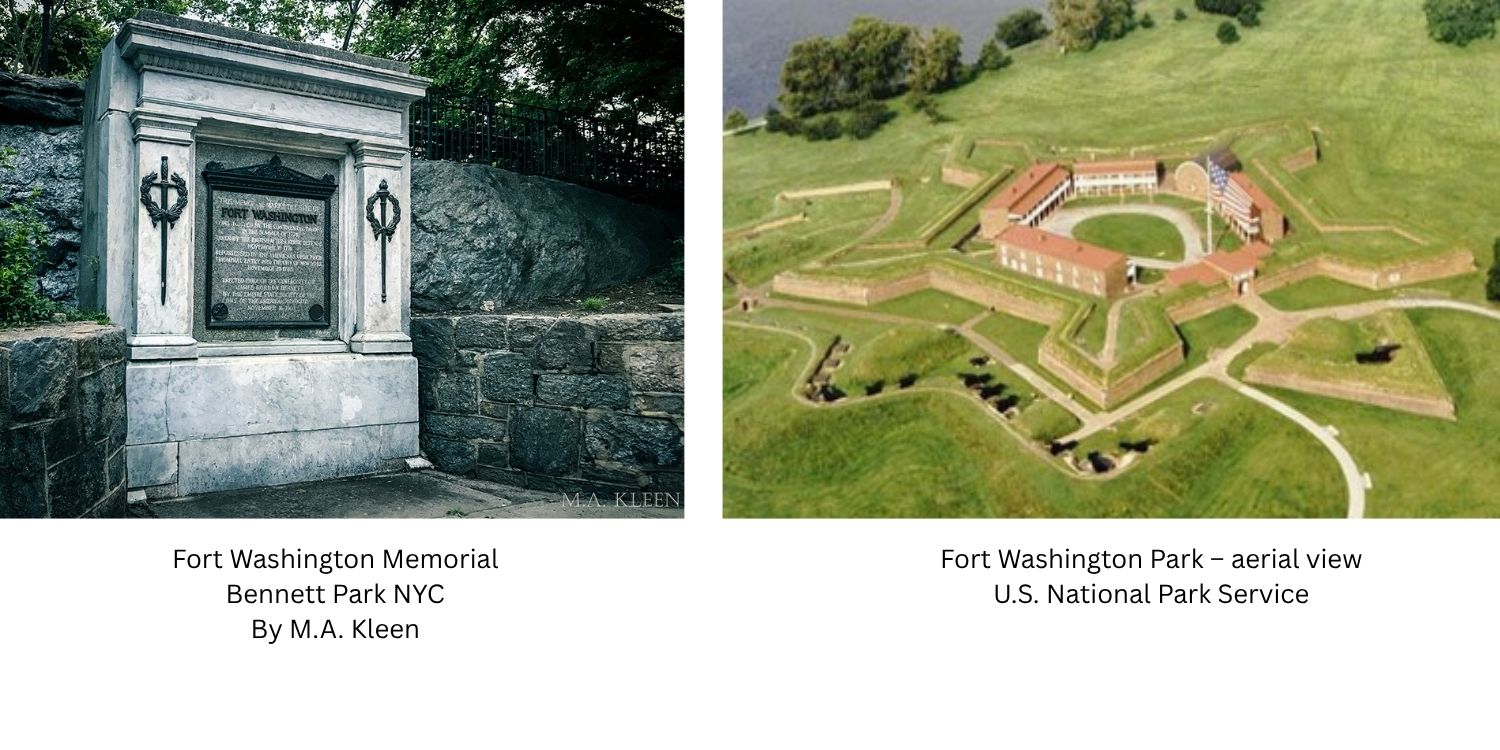
McAllister’s regiment remained at the Flying Camp in Perth Amboy, New Jersey until October 14, when General Mercer, dispatched the regiment to briefly attack the British on Staten Island. After a skirmish there, they were ordered to join Colonel Swope’s regiment at Fort Lee.Soon thereafter, Colonel Swopes regiment and a part of McAllister’s were ordered to Fort Washington, strengthening defenses there to further protect the Hudson River. It was to be an unsuccessful effort. On November 16, the Fort came under an assault by 8,000 of General Howe’s British troops. After British cannon pounded the Fort’s defenses, the attack came from three directions. Despite courageous efforts to defend the Fort, in the end, courage alone was not enough and the entire garrison of nearly 3,000, including 210 officers, was forced to surrender.
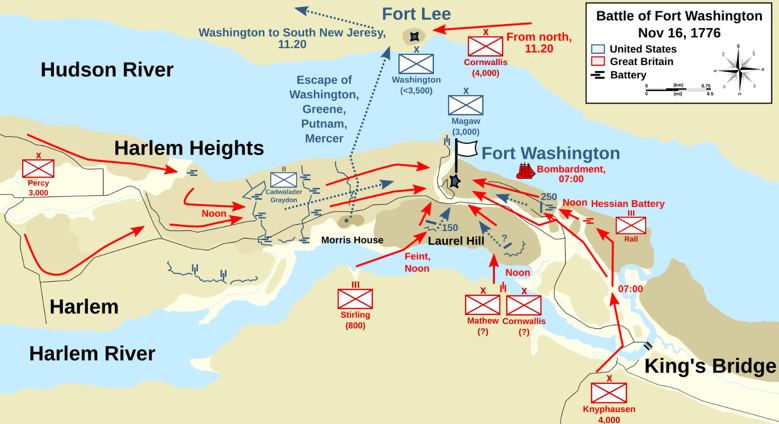
By Oneam - Own work, CC BY-SA 3.0, https://commons.wikimedia.org/w/index.php?curid=27030564
In Pulitzer Prize winning author David McCullough’s 1776, he describes Washington’s struggles to defend New York as follows: "In a disastrous campaign for New York in which Washington’s army had suffered one humiliating, costly reverse after another, this, the surrender of Fort Washington on Saturday, November 16, was the most devastating blow of all, an utter catastrophe."
The captured enlisted men were largely confined in the notorious New York prisons, and prison ships, where many did not survive the harsh conditions. Those who escaped capture retreated with Washington’s army across New York and New Jersey, finally reaching Pennsylvania in December 1776. Their enlistments were expiring just as Washington prepared for the Battle of Trenton, marking the end of the Flying Camp’s short but costly service.Fortunately, the tide would soon turn in the American’s favor with victory at Trenton. With respect to York County’s participation, according to Prowell:
When the attack on Fort Washington began about noon of November 16, 1776, Swope's regiment was defending one of the outposts some distance to the southeast. His position was assaulted by the Hessian troops under Knyphausen. Swope's men fought gallantly, but being overpowered by the enemy, were compelled to fall back. In this movement they were flanked by the British and Hessians and forced to surrender. Almost the entire command of 400 York County soldiers became prisoners of war.
Sadly, York County suffered especially heavy losses at Fort Washington. Fourteen officers, including Colonel Swope were taken prisoner by the British. Although released on parole for some months, Colonel Swope remained a prisoner in New York City until 1781 albeit under much better conditions than the rank and file.Gerhardt Graeff, who had become Captain of the 2 Company under Colonel Swope, along with almost his entire company, was taken prisoner. The Captain later died in captivity. Colonel Thomas Hartley wrote a letter in 1779 stating that of the nearly 400 from Swope and McAllister’s regiments taken prisoners, only 50 had been allowed to return home.
While McAllister was not taken prisoner, two of his captains were. Of the 438 rank and file reported to be in Colonel McAllister’s regiment on October 8, 1776, only 138 remained on December 1 after making their way to Trenton.About one-half of the enlisted men of Swope's and McAllister's regiments were reported to be Pennsylvania Germans who fought gallantly before they surrendered to the enemy.
As for the other officers from Colonel Dill’s battalion, Major Robert Stevenson is listed as a Lieutenant Colonel under Colonel Swope in the Flying Camp and later a Sub-Lieutenant for York County in March of 1777. Captain James Chamberlain was said to have fought in the Battle of Long Island before continuing on in the York County militia, eventually becoming wagon master of York County. Captain William Ashton is listed as the Commandant of Camp Security in 1781 and may have lived in Newberry, but records are not clear. As for John Dill, while he marched to Boston in 1775, was promoted to Lieutenant and is listed as a Major in Colonel Dill’s militia battalion in August 1776, nothing more has been found.
Of the officers and men specifically listed elsewhere as within the Flying Camp, at least one is recognizable. Alexander Nesbit was the son of John Nesbit of Warrington Township. His company was ordered to New Jersey in July of 1776, where it joined the Flying Camp. He became an Ensign in the 7 Company under Captain William Nelson in Colonel Swope’s regiment. By 1779, Ensign Nesbit had returned to York County and had risen to the rank of captain within the York militia. After the war, he moved to Carlisle and in 1801, he moved again to Northumberland County where he operated Nesbit’s Ferry opposite Lewistown.
Second Lieutenant Joseph Welsh served in Colonel Swope’s regiment under Captain Nelson along with Alexander Nesbit. Remarkably, he originally served under Michael Doudel in Thompson’s rifle Brigade – one of the first to march to Boston after Lexington and Concord. Welsh was taken prisoner at Fort Washington and remained as such until 1780 when he was exchanged. When he applied for a pension in 1818, he was living in Delaware County, Pennsylvania.
Another local soldier, William Porter was a 2 lieutenant of the Hamiltons Bann Township Company when the militia was ordered to New Jersey. He later joined the fight at Trenton and Princeton, was injured but survived the war, moved to Monaghan Township and lived until 1824. He is buried in the Monaghan Presbyterian Church Cemetery.
For further information regarding York County’s involvement in the Flying Camp as well as the names of the known causalities, see The History of York County Pennsylvania by George Prowell (1907) at pages 182-183. For a deeper dive into Pennsylvania’s contribution to the Flying Camp, see this article by Francis E. Devine: The Pennsylvania Flying Camp, July - November, 1776 | Pennsylvania History: A Journal of Mid-Atlantic Studies